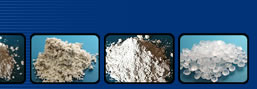
Talc
|
Profile
Talc
is a hydrated magnesium silicate mineral with a laminar
structure. Its minerological composition is hydrated
magnesium silicate. Talc's softness and laminar
structure gives it an exceptionally smooth and slippery
feel. Talc is a relatively good electrical and thermal
insulator, has a high melting point, and offers
extraordinary adsorption of oil and grease. Talc use
used in many industrial applications. Industrial
development will only increase demand for talc, and the
range of its applications is also expected to grow. Talc
is widely used in pharmaceuticals, chemical
applications, textiles, ceramics, and as a sculpture
material.
Chemical composition: Mg3Si4O10(OH)2;
talc's oxidized form has a composition of 3MgO·4SiO2·H2O
and is used as talc powder.
|
|
Talc Powder
Profile
Talc
is a magnesium silicate mineral possessing distinctive
dry slipperiness, low hardness, and a high melting
point. It offers excellent electrical and thermal
insulating properties, low thermal expansion, good
dispersion and covering ability, and excellent water
repellency and affinity for oil. It is very slippery and
has a low coefficient of friction. Its chemical
characteristics are stable. It resists corrosion from
acids and alkalis. Thanks to talc's stable chemical
characteristics, it is widely used by the papermaking,
chemical engineering, paint, ceramics, cable, and rubber
industries.
Talc
powder can improve the molding, extension, extrusion,
and injection performance of rubber and plastic. It can
reduce raw material costs by replacing a portion
(10%-15%) of more costly materials (such as resins). It
can improve the physical properties of paints and
coatings, and resists sunlight, heat, and discoloration
due to UV exposure. It can help paints retain their
original color and luster over prolonged periods of
time. Talc can improve resistance to acids, alkalis, and
water. It resists contamination and aging, increases
abrasion resistance and steam assistance, and enhances
flame retardant performance.
Uses
Talc
powder has an extremely wide range of uses. The greatest
demand is from the papermaking industry, followed by the
waterproof materials industry.
1.Papermaking industry
Talc
powder is used in three different ways in papermaking:
as a filler, and coatings, and as a pulp resin
controller. Talc yields strong, pure white paper. It can
increase opacity and brightness, and and enhance ink
adsorption. Talc is a highly effective color fixative,
and can ensure excellent colors on printed products.
Talc has a very low concave
abrasion value, so it causes extremely little wear to
papermaking and printing equipment. Because its density
is less than that of TiO2, talc is a superior filler to
titanium dioxide. Talc powder is also far less expensive
than titanium dioxide, which makes it highly
competitive.
Talc powder has been used
successfully to remove ink from waste paper, enabling
the effective deinking of waste paper during the
floatation and washing stages.
2.Waterproof materials industry
Talc
powder can be used as a filler in building materials
such as linoleum, building facing paper, asphalt
shingles, and building panels, and can also be applied
to building facing materials as an anti-stick agent.
Talc used as a filler in asphalt products also serves as
a stabilizer, and increases the stability and weathering
resistance of building materials. Talc powder can be
sprinkled on asphalt shingles or rolled building facing
materials to prevent sticking during production and
storage. The waterproof materials industry typically
uses low-grade colored and impure coarsely-ground talc
powder.
3.Other
industries
Talc
has many important uses in the plastic industry, rubber
industry, cable industry, ceramics industry, paints and
coatings industry, and textile industry.
|
Specifications |
|
KING SIGMA CORP
Talc powder |
|
Grade |
UFO |
N-A 2500 |
N-A 1250 |
S-A 950 |
S-A 325 |
K-S 900 |
A-L 500 |
|
Chemical analysis |
|
SiO2 |
62 |
62 |
61 |
61.5 |
60.8 |
60.6 |
57 |
|
MgO |
31.3 |
31.3 |
31.2 |
31.5 |
31.2 |
31.4 |
31.5 |
|
Al2O3 |
0.1 |
0.1 |
0.12 |
0.1 |
0.25 |
0.2 |
0.4 |
|
Fe2O3 |
0.25 |
0.25 |
0.26 |
0.25 |
0.3 |
0.28 |
0.4 |
|
CaO |
0.43 |
0.43 |
0.5 |
0.5 |
0.5 |
0.5 |
0.8 |
|
Loss on ignition |
5.8 |
5.8 |
6 |
6 |
6 |
6 |
8 |
|
|
|
Physics properties |
|
Whiteness |
95° |
95° |
93° |
95° |
90° |
90° |
89° |
|
Mesh |
|
|
|
325 |
325 |
325 |
325 |
|
pH |
8.5±0.5 |
8.5±0.5 |
8.5±0.5 |
8.5±0.5 |
8.5±0.5 |
8.5±0.5 |
8.5±0.5 |
|
Density |
2.65±0.05 |
2.65±0.05 |
2.65±0.05 |
2.65±0.05 |
2.65±0.05 |
2.65±0.05 |
2.65±0.05 |
|
Oil absorption |
60ml/100g |
50ml/100g |
48ml/100g |
42ml/100g |
40ml/100g |
38ml/100g |
40ml/100g |
|
Average particle size(μ) |
1.7±0.5 |
3.5±0.5 |
7±0.5 |
9.5±1 |
10.5±1 |
10.5±1 |
12±1 |
|
|
|
Major uses |
|
Pharmaceuticals |
☉ |
☉ |
☉ |
☉ |
|
|
|
|
Cosmetics |
☉ |
☉ |
☉ |
☉ |
☉ |
☉ |
|
|
Paints and coatings
|
☉ |
☉ |
☉ |
☉ |
☉ |
☉ |
☉ |
|
Plastics |
☉ |
☉ |
☉ |
☉ |
☉ |
☉ |
☉ |
|
Rubber |
☉ |
☉ |
☉ |
|
☉ |
☉ |
☉ |
|
Paper |
☉ |
☉ |
☉ |
|
☉ |
☉ |
☉ |
|