|
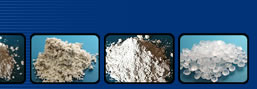
Kaolin (Kaolin
Clay)
Profile
Kaolin
is a kind of finely-ground clay mainly produced
from minerals in the kaolinite group. It is
widely used in paper, coatings, paints, paint
thickeners, pigments, color stabilizers,
catalyst carriers, as an insulating agent in
cosmetics, in electronic elements and inks, and
as a reinforcing agent in rubber and plastics.
It can partially replace titanium white. It
outperforms titanium white in terms of surface
activity and adsorption. In paints and coatings,
it can improve viscosity stability, enhance
resistance to rock abrasion, improve
brushability and moisture resistance, and
prevent pavement floating and blooming.
As
an adsorbent, it can be used in special hull
paints to increase abrasion resistance and water
resistance. It can also increase abrasion
resistance in tires. The most important
industrial users of kaolin are the papermaking
industry, enamel industry, rubber industry, and
ceramics industry. The composition of kaolin is
close to the theoretical Al2O3 and SiO2 values
of kaolinite, which makes it useful as a
papermaking coating, and in radio ceramics and
fire-resistant crucibles. In addition, the Al2O3
content can be reduced and the SiO2 content
appropriately increased for application in
everyday ceramics and sanitary ceramics, as a
raw material for white cement, and as a filler
in rubber and plastic. There are different
permissible amounts of harmful components such
as Fe2O3, TiO2, and SO3. There are different
permissible amounts of CaO, MgO, K2O, and Na2O
when kaolin is used in different applications.
Different performance aspects are likewise
required in different applications. For
instance, the papermaking industry chiefly
demands whiteness, low stickiness, and fineness;
the ceramics industry asks for excellent
plasticity, molding performance, and whiteness
after firing; the fire-resistant materials
industry demands a high degree of
fire-resistance; and the enamel industry demands
superior suspension ability.
Uses
1.
In ceramics:
Kaolin
offers good plasticity, adhesion, and sintering
performance. Kaolin products are white,
fine-textured, and mechanically strong. It can
be used to make high and low piezoelectric
ceramics; other uses include various ceramic
blanks and glazes, and various kinds of
fire-resistant materials.
2.
In paints and coatings:
Kaolin is
used as a body pigment and multifunctional
additive in place of lithopone and titanium
white, and it is suitable in any paint or
coating system. It provides high brightness and
covering ability in paints and coatings, and can
improve paint storage stability, brushability,
and durability, and can enhance the impact
resistance and other mechanical performance of
paint and coating layers.
3.
In oil-based paints and plastics:
The
addition of kaolin can improve the suspension,
viscosity, adhesion, and high-temperature firing
performance of enamel glaze. It can also insure
that a fired enamel glaze adheres tightly to an
iron body.
4.
In rubber:
Aluminum
silicate carbon black made using coal-measure
kaolin and subjected to surface modification can
greatly enhance reinforcement of rubber, and is
used in auto tires and EPDM, etc. This filler
can even surpass the reinforcing performance of
carbon black and white carbon black in certain
respects.
5.
In papermaking:
Besides
good covering power and luster, kaolin can also
yield excellent softness and depth and good
printability. Kaolin is chiefly used in coated
paper, copper printing paper, coated white
cardboard, and cast coated paper.
Calcined
Kaolin
|
Profile
High-temperature
calcining improves the physical
performance (whiteness, density,
porosity, and bulkiness),
chemical performance (adsorptivity,
reactivity), and optical,
electrical, and magnetic
properties of coal-measure hard
kaolin. Calcined kaolin is
widely used in paper, paints,
and coatings.
Uses
Calcined
kaolin has the following wide
range of uses:
|
|
1. In
Coating
Calcined kaolin improves
structural strength in both water- and
oil-based paints. It offers good
dispersion, chemical stability,
corrosion resistance, fire resistance,
scrubbing resistance, and mechanical
characteristics. It can further improve
the storage stability, brushability,
moisture assistance, and impact
resistance of paints and coatings. It
resists floating and blooming in
pigments, improves covering power,
durability, and heat and weather
resistance, and offers good opacity and
adsorption. It can partially replace
titanium white. The use of calcined
kaolin in inner and outer wall coatings,
high-end paints, inks, and marker line
paint can directly cut costs.
2.
In rubber products
Calcined
kaolin is used as a filler in the rubber
industry, and can improve products'
physical and chemical properties. It has
a significant reinforcing action, is an
electrical insulator, and can improve
tear resistance, tensile strength, aging
resistance, and corrosion resistance. It
can enhance solubility in latex,
increase vulcanization hardness and
abrasion resistance, and boost flex life
and smoothness. It can cut costs when
used as a replacement for such costly
materials as abrasion-resistant carbon
black, ordinary carbon black, white
carbon black, aluminum silicate carbon
black, and magnesium oxide.
3.
In ceramics
Use of calcined kaolin ensures that
products will have a white,
fine-textured, glossy surface. It can
boost mechanical strength and reduce
defect rate. Calcined kaolin is suitable
for use as a blank material and glaze in
everyday ceramics, construction
ceramics, corrosion-resistant chemical
engineering ceramics, crafts and art
ceramics, sanitary ceramics, and high
and low piezoelectric ceramics.
4.
In glass products
Calcined
kaolin replace costly alumina. When used
as a filler in white glass products, it
can improve product quality and reduce
production costs.
5.
In plastics
Calcined
kaolin can enhance the strength of
greenhouse film, ground film, cable
insulation, and PVC pipe (sheet). Apart
from whiteness and electrical insulating
properties, it also allows diffuse light
transmission and blocks infrared when
used in plastic film. It can reduce cost
when used as a bulk filler.
6.
In papermaking
The laminar structure of calcined kaolin
makes it a useful coating pigment in
papermaking. Apart from good covering
ability and relatively high luster,
calcined kaolin's porous structure can
increase the porosity, soft bulk, and
smoothness of coating layers. It lends
opacity and flexibility to paper,
improves ink adsorption, enhances
luster, and reduces printing spots.
7.
In fire-resistant materials
Calcined
kaolin is used for linings in metallurgy
and chemical engineering. Uses include
kiln linings, high-temperature fusion
crucibles, and various types of bricks,
tiles, rods, plates, and
non-standard-shape fire-resistant and
heat-resistant materials.
8.
In pesticides and petrochemicals
Calcined kaolin
particles are covered with tiny pores
that give this material tremendous
adsorptivity. Calcined kaolin can be
used in pharmaceuticals and pesticides.
Because it is neutral and has a high
silicon content, it can be used in
silicon fertilizer, and can also be used
as an animal feed additive. It is used
as a catalyst in petroleum refining. It
possesses relatively high basal
activity, strongly resists contamination
by heavy metals, and offers good
catalytic activity and selectivity.
9.
In materials and modern technology
The
modern materials industry uses calcined
kaolin in the production of composite
materials. It is compatible with both
metallic and nonmetallic materials,
while offering performance superior to
that of metallic and nonmetallic
materials in some respects. Calcined
kaolin provides good mechanical
strength, impact resistance, radiation
resistance, heat resistance, and
corrosion resistance. Because of these
properties, it can be used for
high-temperature combustion chambers,
nozzles, and cylinders in autos,
aircraft, and rockets, etc., and is used
in other special and high-strength
ceramics.
10.
In cosmetics
Calcined
kaolin is used as a white body pigment
employed in facial masks, facial powder,
toothpaste, and other everyday products.
It can cut costs when used instead of
titanium white.
|
|